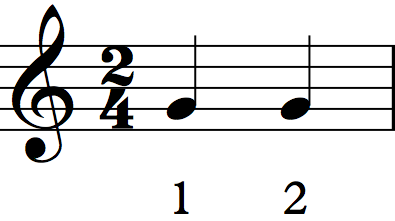
Music Meter Signature : 06 Compound Meter And Time Signatures - An odd meter is a meter that contains both simple and compound beats.. Thousands of songs have been written in this meter, so it's time for you to try writing in it as well! 2 = simple double, 3 = simple triple, 4 = simple quadruple, 6 = compound double, 8 = compound triple, and 12 = compound quadruple. 3:4 time indicates three beats per measure n. The most common time signatures are 2/4, 3/4, 4/4. 2:4 time indicates two beats per measure bottom:
Meter and time signatures refer to the same concept, but they are used slightly differently. The time signature (also known as meter signature, metre signature, or measure signature) is a notational convention used in western musical notation to specify how many beats (pulses) are contained in each measure (), and which note value is equivalent to a beat. What are note values in music? An example of a complex time signature is 5/4. Each dotted quarter note (the beat) gets a count, which is still expressed in
3 Simple Meters Fundamentals Function And Form from milnepublishing.geneseo.edu Each section of music has a meter that is defined by the time signature. The most common time signatures are 2/4, 3/4, 4/4. 3:4 time indicates three beats per measure n. While this is arguably extremely common in music, the notations 8 4 and 8 8 themselves are not, so all divisions of this time signature are listed here 8 4. The time signature shows us the relationship between the number of beats in a measure and the type of beat that is used. You'll be surprised how much it can change the groove of your song and make it flow differently. 2 = simple double, 3 = simple triple, 4 = simple quadruple, 6 = compound double, 8 = compound triple, and 12 = compound quadruple. A time signature appears at the beginning of a piece of music to show the time or meter of the music.
These meters aren't nearly as common, but they're important to be able to recognize in a piece of sheet music.
A rhythm with counts in a compound duple meter. You'll be surprised how much it can change the groove of your song and make it flow differently. Each measure in this time signature should have two beats (take the 6—the top number—and divide it by three; While this is arguably extremely common in music, the notations 8 4 and 8 8 themselves are not, so all divisions of this time signature are listed here 8 4. Each section of music has a meter that is defined by the time signature. Most pieces of music, especially at the earlier levels, are in one time signature. An example of a complex time signature is 5/4. Meter and time signatures refer to the same concept, but they are used slightly differently. We call time signatures that contain odd meters complex time signatures. It's a super useful tool to have in your songwriting toolbox. What is mixed meter in music? Standard meters in western music can be classified into simple meters and compound meters, as well as duple, triple, and quadruple meters. Meter is the property of music that it is based on an underlying, repeating beat rhythm, whereas time signatures are the symbols we use to identify and describe the meter in a piece of music.
I wish to teach this was just as easy as saying, in 2/4, there are 2 beats in every measure, and in 4/4, there are 4 beats in every measure, but as we all know, it is much more complicated than this. What are note values in music? These meters aren't nearly as common, but they're important to be able to recognize in a piece of sheet music. Here are the beats for a simple meter measure: 2 = simple double, 3 = simple triple, 4 = simple quadruple, 6 = compound double, 8 = compound triple, and 12 = compound quadruple.
More Open Strings Rhythms Time Signatures Sight Reading For Guitar from press.rebus.community The top number of the time signature is 2, 3 or 4, depending on how many main beats per bar there are. This video aims to help learners understand rhythmic patterns, meter and time signature.#music5 #melc #notesandrests #dottednotes #numberofbeats _____. To practice different time signatures and meters, let's hear some examples using popular music. A time signature is a sign which helps show you what the meter is. Crotchets (quarter notes), quavers (eighth. Meter and time signatures meter involves the way multiple pulse layers work together to organize music in time. See spelling differences) refers to the regularly recurring patterns and accents such as bars and beats.unlike rhythm, metric onsets are not necessarily sounded, but are nevertheless implied by the performer (or performers) and expected by the listener. When discussing music, the terms time signature and meter are frequently used interchangeably;
It's a super useful tool to have in your songwriting toolbox.
This means that each measure (bar) of music has the same number of beats. The top number of the time signature is 6 (2 beats), 9 (3 beats) or 12 (4 beats). Meter and time signatures refer to the same concept, but they are used slightly differently. A 3/4 time signature means that we need three quarter notes to complete a measure. not verified in bodya variety of systems exist throughout the world for. A beat with 6/8 time signature can be divided by two or three, it depends on the context. When looking at the top number, it tells you the type of meter of the song: The result, two, indicates a duple meter). A time signature is a sign which helps show you what the meter is. The meter signature or time signature is an indicator of the meter of a musical work, usually presented in the form of a fraction, the denominator of which indicates the unit of measurement and the numerator of which indicates the number of units that make up a measure. Meter and time signatures meter involves the way multiple pulse layers work together to organize music in time. 8 may refer to an evenly divided compound duple or quadruple meter. See more ideas about music classroom, teaching music, music education.
What is a time signature? Now we can get to time signatures. Time signatures are also referred to as meter signatures, and the time signatures tell you the meter for the song. Musictheory metre or meter is the measurement of a musical line into measures of stressed and unstressed beats, indicated in western music notation by a symbol called a time signature. 2:4 time indicates two beats per measure bottom:
Free Downloads Rhythm Bar Lines Meter Note Values from www.sheetmusic1.com An odd meter is a meter that contains both simple and compound beats. The top number of the time signature is 6 (2 beats), 9 (3 beats) or 12 (4 beats). In that case (simple meter): While this is arguably extremely common in music, the notations 8 4 and 8 8 themselves are not, so all divisions of this time signature are listed here 8 4. See more ideas about music classroom, teaching music, music education. This means that each measure (bar) of music has the same number of beats. not verified in bodya variety of systems exist throughout the world for. This video aims to help learners understand rhythmic patterns, meter and time signature.#music5 #melc #notesandrests #dottednotes #numberofbeats _____.
What are note values in music?
Musictheory metre or meter is the measurement of a musical line into measures of stressed and unstressed beats, indicated in western music notation by a symbol called a time signature. A 3/4 time signature means that we need three quarter notes to complete a measure. The top number of the time signature is 2, 3 or 4, depending on how many main beats per bar there are. It's a super useful tool to have in your songwriting toolbox. A time signature appears at the beginning of a piece of music to show the time or meter of the music. 2 = simple double, 3 = simple triple, 4 = simple quadruple, 6 = compound double, 8 = compound triple, and 12 = compound quadruple. What are note values in music? This means that each measure (bar) of music has the same number of beats. Most pieces of music, especially at the earlier levels, are in one time signature. Each dotted quarter note (the beat) gets a count, which is still expressed in It gives you the best of both worlds. The most common time signatures are 2/4, 3/4, 4/4. To practice different time signatures and meters, let's hear some examples using popular music.