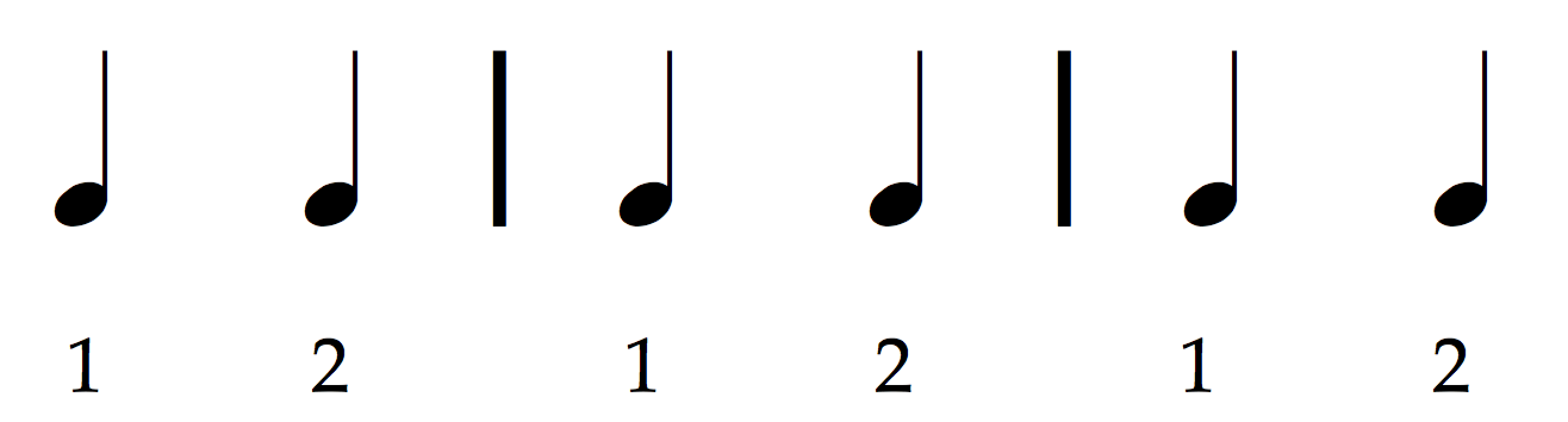
Music Meters Explained : Understanding Time Signatures And Meters A Musical Guide - The most common meter in music is 4/4.. (the and is how musicians say eighth notes). Metre, also spelled meter, in music, rhythmic pattern constituted by the grouping of basic temporal units, called beats, into regular measures, or bars; Musictheory metre or meter is the measurement of a musical line into measures of stressed and unstressed beats, indicated in western music notation by a symbol called a time signature. Consider the first version above. In music, metre(commonwealth spelling) or meter(american spelling;
These meters display in dbfs and only tell you whether your audio signal is clipping or not going red. Equivalent to the associated board (abrsm) music theory exams grades 1 & 2 the video star. A beat can be regular or irregular. Learn about music theory in mr. The time signature (also known as meter signature, metre signature, or measure signature) is a notational convention used in western musical notation to specify how many beats (pulses) are contained in each measure (bar), and which note value is equivalent to a beat.
Time Signatures Meters Everything You Need To Know School Of Composition from www.schoolofcomposition.com Unlike rhythm, metric onsets are not necessarily sounded, but are nevertheless implied by the performer (or performers) and expected by the listener. These meters display in dbfs and only tell you whether your audio signal is clipping or not going red. See spelling differences) refers to the regularly recurring patterns and accents such as barsand beats. A beat can be regular or irregular. The cymbal plays a normal 4/4 beat (plus one 2/4 measure), but the snare drum and the bass drum superimpose an additional rhythm, which is indicated by the blue lines, and which can be analyzed as four 7/8 measures. Talking about rhythm and meter in poetry, including major metrical feet, how to hear stressed and unstressed syllables, and how many feet are in a line. Like punctuation marks, dynamics abbreviations and symbols indicate moments of emphasis. In music, metre(commonwealth spelling) or meter(american spelling;
This video explains and discusses the most common time signatures.
Consider the first version above. The cymbal plays a normal 4/4 beat (plus one 2/4 measure), but the snare drum and the bass drum superimpose an additional rhythm, which is indicated by the blue lines, and which can be analyzed as four 7/8 measures. Before we get into actual time signatures, we have to talk a little bit about meter. Unlike rhythm, metric onsets are not necessarily sounded, but are nevertheless implied by the performer (or performers) and expected by the listener. After all, time signatures represent meter in written music. Drums will often mark out the meter when they are played. Meter involves the way multiple pulse layers work together to organize music in time. Mensural notation and origins of rhythmic value mensural notation was used in music notation from the late 13th century to around 1600. The trusty vu meter was something like the original loudness meter. (the and is how musicians say eighth notes). Meter is notated at the beginning of a composition with a time signature. This video explains and discusses the most common time signatures. So far we have encountered two of the most common, 4/4 and 3/4.
Music production should always sound pleasant, dynamic, and equal in terms of the perceived loudness. We cover lots of terms and look at some examples. Musictheory metre or meter is the measurement of a musical line into measures of stressed and unstressed beats, indicated in western music notation by a symbol called a time signature. Rhythmic patterns produced by grouping together strong and weak beats. Meter is a term used by musicians to describe larger groups that repeat throughout a piece of music.
Part 4 Time Signatures Explained Writing Songs In Odd Meters from s7d1.scene7.com In western notation, each measure is set off from those adjoining it by bar lines. A meter may be two or more beats in a measure. In 4/4, the stacked numbers tell you that each measure contains four quarter note beats. A beat can be regular or irregular. You can determine these groupings aurally by listening carefully and tapping along to the beat. You might have sometimes tried to count along with a pi. Unlike rhythm, metric onsets are not necessarily sounded, but are nevertheless implied by the performer (or performers) and expected by the listener. While most decisions in the studio are, naturally, made by ear, audio meters are useful tools at every stage of production.
The slower attack time allows the faster transients to get by before it registers the signal and gives a reading.
1 and 2 and 3 and 4 and 5 and 6 and 7 and 8, etc. Mensural notation and origins of rhythmic value mensural notation was used in music notation from the late 13th century to around 1600. The top number tells you how many beats to a measure, the space of staff in between each vertical line (called a bar). A simple meter is a particular type of meter, the grouping of strong and weak beats in musical composition that establishes the basic rhythm of a particular piece or section of a piece of music. The most common meter in music is 4/4. Composers writing in 3/4 time may also use a dotted half note which is also equivalent to three beats. It's so common that its other name is common time and the two numbers in the time signature are often replaced by the letter c. Meter is a recurring pattern of stresses or accents that provide the pulse or beat of music. The trusty vu meter was something like the original loudness meter. This video explains and discusses the most common time signatures. Consider the first version above. Drums will often mark out the meter when they are played. In music, metre(commonwealth spelling) or meter(american spelling;
Standard meters in western music can be classified into simple meters and compound meters, as well as duple, triple, and quadruple meters. If the rhythm and meter are the heart of the music, and notes and keys are the brains, then dynamics are surely the voice of the music. The time signature (also known as meter signature, metre signature, or measure signature) is a notational convention used in western musical notation to specify how many beats (pulses) are contained in each measure (bar), and which note value is equivalent to a beat. When reading music, the meter is presented similar to a fraction, with a top number and a bottom number, we call this the song's time signature. The volume of a performance.
Section 2 1 Meter And Time Signatures Offtonic Theory from offtonic.com When reading music, the meter is presented similar to a fraction, with a top number and a bottom number, we call this the song's time signature. Before we get into actual time signatures, we have to talk a little bit about meter. Composers writing in 3/4 time may also use a dotted half note which is also equivalent to three beats. Meter is a recurring pattern of stresses or accents that provide the pulse or beat of music. A volume unit or vu meter is a basic volt meter that takes a simple average of the signal and displays it with an attack and release time of around 300 ms. A beat can be regular or irregular. The top number tells you how many beats to a measure, the space of staff in between each vertical line (called a bar). We cover lots of terms and look at some examples.
Composers writing in 3/4 time may also use a dotted half note which is also equivalent to three beats.
Meter is a recurring pattern of stresses or accents that provide the pulse or beat of music. Duple meters have groupings of two beats, triple meters have groupings of three beats, and quadruple meters have groupings of four beats. After all, time signatures represent meter in written music. A volume unit or vu meter is a basic volt meter that takes a simple average of the signal and displays it with an attack and release time of around 300 ms. In 4/4, the stacked numbers tell you that each measure contains four quarter note beats. The most common meter in music is 4/4. The cymbal plays a normal 4/4 beat (plus one 2/4 measure), but the snare drum and the bass drum superimpose an additional rhythm, which is indicated by the blue lines, and which can be analyzed as four 7/8 measures. In music, metre(commonwealth spelling) or meter(american spelling; Unlike rhythm, metric onsets are not necessarily sounded, but are nevertheless implied by the performer (or performers) and expected by the listener. You might have sometimes tried to count along with a pi. The volume of a performance. In 3/4 meter the accent is usually on the first beat. Equivalent to the associated board (abrsm) music theory exams grades 1 & 2 the video star.
Metre, also spelled meter, in music, rhythmic pattern constituted by the grouping of basic temporal units, called beats, into regular measures, or bars; meters music. Mensural notation and origins of rhythmic value mensural notation was used in music notation from the late 13th century to around 1600.